Picture this: You’re already five minutes late for a meeting in downtown Hillsboro. You hop into your car, turn the key or push the start button, and… nothing. Maybe you hear a frantic clicking sound, or perhaps there’s just a heavy, sinking silence.
At that moment, your mind probably goes straight to the battery. While a dead battery is a common culprit, it’s often just a symptom of a deeper issue. Could it be the starter? Or is the alternator failing to keep things charged?
Understanding the difference between these two components can save you a lot of stress and prevent you from replacing parts you don't actually need. Let’s break down the "who’s who" of your car’s electrical system and help you figure out why your vehicle is giving you the cold shoulder.
The Electrical Trio: How They Work Together
Before we dive into the specific symptoms, it helps to understand how your car’s electrical "ecosystem" functions. Think of it as a three-part relay race involving the battery, the starter, and the alternator.
- The Battery: This is your car’s storage tank for electricity. It provides the initial burst of energy needed to wake the car up.
- The Starter: This is a small but powerful electric motor. Its only job is to "crank" the internal combustion engine to get it spinning fast enough to start running on its own.
- The Alternator: Once the engine is running, the alternator takes over. It’s a generator that creates electricity to power your headlights, radio, and AC, while simultaneously recharging the battery for the next start.
If any one of these three fails, the relay race stops, and you’re left stranded. But how do you know which one dropped the baton?

The Starter: The "Key" to Everything
The starter is essentially a middleman. When you turn your ignition key, a small amount of electricity travels from the battery to the starter solenoid. This activates the starter motor, which pushes a small gear into the engine's flywheel, spinning the crankshaft and bringing the engine to life.
But what happens when the starter decides to retire? Since the starter is only used for those first few seconds of operation, the symptoms are very specific to the moment of ignition.
Symptoms of a Failing Starter
Have you ever noticed your car acting up only during the first five seconds of your commute? That’s a classic sign. Here is what to look for:
- The Single Click or Rapid Clicking: If you turn the key and hear one loud clack or a series of rapid clicks, the starter solenoid might be receiving power but failing to engage the motor.
- The "Whirring" Sound: Sometimes the starter motor spins, but it doesn't engage the engine. It sounds like a high-pitched spinning noise, often called "freewheeling."
- Grinding Noises: This sounds a lot like what happens when you accidentally try to start a car that’s already running. It usually means the starter gears are worn out or not aligned properly with the flywheel.
- Smoke and Smells: Because the starter is an electric motor, it can overheat if you try to crank the engine for too long. If you see smoke or smell burning insulation, stop immediately.
- Intermittent Starting: This is the most frustrating symptom. Your car might start perfectly fine on Monday, but refuse to budge on Tuesday morning.
If you suspect your starter is the issue, we invite you to check out our automotive repair services in Hillsboro to get a definitive answer.
The Alternator: The On-Board Power Plant
While the starter is a "one-hit wonder" that does its job and goes to sleep, the alternator is the marathon runner of your car. It works every second the engine is running. If the alternator fails, your car is essentially running on "borrowed time": eventually, the battery will drain completely because nothing is putting power back into it.
Symptoms of a Failing Alternator
Because the alternator powers almost everything while you drive, its failure symptoms are often more "visual" and involve your car's electronics.
- Dim or Overly Bright Lights: Are your headlights flickering or looking a bit yellow? Or perhaps your dashboard lights suddenly get super bright when you rev the engine? This indicates the alternator is struggling to regulate voltage.
- The Battery Warning Light: Many people think the little red battery icon on the dashboard means the battery is bad. In reality, that light usually indicates a charging system failure: which is almost always the alternator.
- Electrical Gremlins: Modern cars are computers on wheels. If the alternator isn't providing steady power, you might notice your power windows moving slowly, your radio cutting out, or your heated seats failing to warm up.
- Stalling While Driving: This is the big one. If your car dies while you’re waiting at a stoplight or driving down the road, it’s likely because the alternator stopped providing power, and the battery finally ran dry.
- Growling or Squealing Noises: The alternator is driven by a belt (often the serpentine belt). If the bearings inside the alternator are failing, you might hear a growling or whining noise that changes pitch with the engine speed.

The "Jumper Cable" Test: A Quick DIY Diagnostic
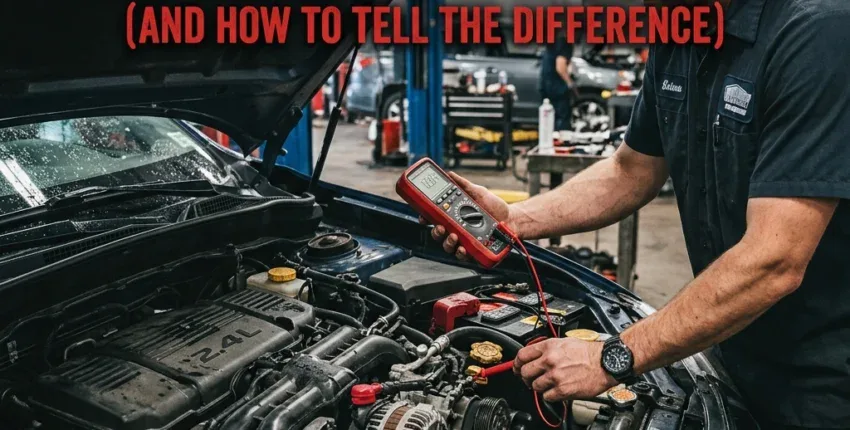
If you’re stuck in your driveway right now, there is a simple way to narrow down the culprit using a pair of jumper cables and a "helper" car.
- Try to Jump-Start the Car: Hook up the cables to a running vehicle.
- If the car starts immediately: Your battery was likely just low. However, you still need to figure out why it was low. Let the car run for a few minutes and then disconnect the cables.
- If the car dies shortly after disconnecting cables: Your alternator is likely the problem. It isn't producing enough power to keep the engine running, and the battery is too weak to pick up the slack.
- If the car won't even try to crank with the cables attached: If you have a good connection and the lights in your car are bright, but you still just hear a "click," your starter is the most likely suspect.
Of course, these DIY tests aren't foolproof. Electrical systems can be tricky, which is why we always recommend a professional engine diagnostic to be 100% sure.
Why Does It Matter Which One It Is?
You might be thinking, "A broken car is a broken car, why do I care which part is bad?"
The answer is simple: Your wallet.
Replacing an alternator when the problem was actually a $20 loose wire or a worn-out starter is a mistake that happens all too often at DIY-focused shops. At Clay's Auto Service, we pride ourselves on being reliable partners for our Hillsboro neighbors. We don't just "parts-cannon" a problem; we find the root cause.
For instance, did you know that a bad alternator can actually kill a brand-new battery? If the alternator overcharges the battery, it can "cook" the internal components. Conversely, if it undercharges, the battery will eventually become "sulfated" and lose its ability to hold a charge.

How to Protect Your Starting System
We believe that proactive maintenance is always better than an emergency tow. To keep your starter and alternator in top shape, here are a few tips:
- Keep it Clean: Corrosion on battery terminals can increase resistance, making the starter work harder and the alternator struggle to charge. A quick cleaning with a wire brush can do wonders.
- Check Your Belts: Since the alternator is belt-driven, a slipping or cracked belt will prevent it from spinning at the correct speed.
- Listen to Your Car: Your car usually tries to tell you it's sick before it actually dies. If you hear a new whine, groan, or click, don't wait for the breakdown.
- Get a Battery Test: Every time you come in for an oil change at Clay's, we can check your battery's health. A weak battery puts unnecessary strain on both the starter and the alternator.
Peace of Mind in Hillsboro
Dealing with a car that won't start is incredibly stressful, but you don't have to navigate it alone. Whether it's a simple battery swap, a complex alternator replacement, or a new starter motor, our team is here to help you get back to your life with minimal disruption.
Need a hand? You can contact us today to schedule a diagnostic appointment. We’ll test the entire system: battery, starter, and alternator: to ensure we fix the right part the first time.
Before you head in, don't forget to check our online specials to see if you can save on your next visit. We’ve been serving the Hillsboro community with reliable, honest repair work for years, and we’d love to show you the Clay's Auto Service difference.
So, the next time your car gives you that dreaded silence or that rhythmic clicking, remember: it’s just a relay race that needs a little bit of expert tuning. We'll see you at the shop!